
The bass clef symbol plays a vital role in the world of music notation, especially for lower-pitched instruments and voices. While many beginners start their musical journey reading the treble clef, the bass clef is equally essential for understanding the full range of written music. It anchors the lower register of the musical staff, providing a framework for notes that are often foundational to harmony and rhythm.
Recognizing the bass clef is simple once you know what to look for: it resembles a stylized backward “C” with two dots placed on either side of a staff line. This line identifies the note F below middle C, which is why the bass clef is often called the F clef. Whether you’re playing the left hand of the piano or performing on a tuba, bassoon, or bass guitar, understanding this symbol is a crucial skill that will expand your musical fluency and deepen your appreciation of music theory.
What is the Bass Clef?
The bass clef, also known as the F clef, is a type of musical clef that determines the pitch range of the notes written on the staff. Specifically, it locates the note F below middle C (F3) on the fourth line of the five-line staff. This positioning is what gives the bass clef its alternative name—the F clef.

Unlike the treble clef, which is used for higher-pitched instruments and voices, the bass clef is intended for lower registers. This includes not only the left hand of the piano but also instruments such as the double bass, cello, bassoon, trombone, and tuba, as well as vocal parts like bass or baritone.
The clef allows composers and arrangers to avoid using excessive ledger lines when writing low notes. Without the bass clef, scores for these instruments would be cluttered and harder to read. Understanding the bass clef helps musicians fluently read a broader range of pitches and supports ensemble cohesion in orchestral or band settings, where multiple clefs are used in harmony.
>>View more: List 99+ Music Symbols and Their Functions
Anatomy of the Bass Clef Symbol
The bass clef symbol has a distinctive and elegant shape that reflects its historical and practical role in music notation. Visually, it appears as a curved hook that curls around the fourth line of the staff, accompanied by two dots placed above and below that same line. This fourth line is crucial—it marks the position of the note F3, which is why the bass clef is also known as the F clef.
The curve of the clef begins below the staff and loops upward, guiding the eye naturally toward the F line. The two dots further emphasize this line, reinforcing its importance as a visual anchor. While other clefs like the treble clef (G clef) highlight different pitches, the bass clef’s structure is deliberately designed to emphasize the lower part of the pitch spectrum.

Understanding this anatomy not only helps in recognizing the clef on a page but also aids in mentally mapping where notes are placed relative to the F line. Once this visual association becomes familiar, reading music in the bass clef becomes significantly more intuitive for both beginners and experienced musicians alike.
>>Learn more about other music clef symbols
Notes on the Bass Clef Staff
Learning the note positions in the bass clef is essential for reading and interpreting music accurately. Unlike the treble clef, where the note G is marked, the bass clef sets the note F3 on the fourth line. From there, notes ascend and descend following the musical alphabet.
The lines of the bass clef staff, from bottom to top, represent the notes G–B–D–F–A. A popular mnemonic to remember this sequence is: “Good Boys Do Fine Always.” The spaces, on the other hand, correspond to A–C–E–G, remembered by the phrase “All Cows Eat Grass.”
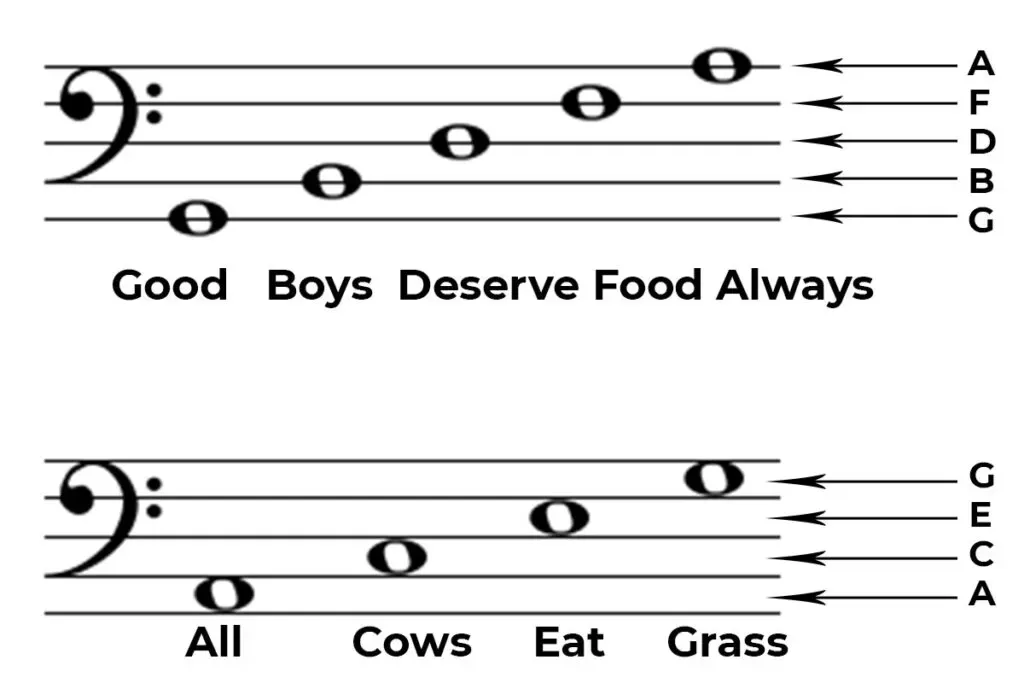
Having these patterns internalized helps musicians quickly identify and play notes without needing to count up or down from middle C every time. It’s also beneficial to practice with flashcards or staff trainers that reinforce these positions. Visualizing these note locations and their associated sounds develops sight-reading skills, making it easier to interpret sheet music across genres and styles. Regular practice with bass clef note reading strengthens a musician’s versatility and musical comprehension.
Instruments That Use the Bass Clef
The bass clef is used by a variety of instruments and voice types that operate within the lower pitch ranges. In keyboard instruments like the piano or organ, the bass clef typically governs the left hand, where the lower notes are played. For string instruments, the cello and double bass are primary users of this clef, as their natural register lies below middle C.
In wind and brass families, the bassoon, trombone, tuba, and euphonium are standard bearers of the bass clef. These instruments often provide harmonic foundation and rhythmic support in ensembles. The bass guitar, a staple of many modern music genres, also reads in the bass clef, as does the baritone horn.
Additionally, in choral music, the bass and baritone voices use the bass clef. These lower vocal parts help anchor the harmony and give choral arrangements depth. Understanding the clef is essential for these musicians, as it ensures accurate pitch placement and synchronization with higher-pitched instruments or singers using treble or alto clefs.
Reading and Writing in the Bass Clef
Mastering the ability to read and write in the bass clef can be challenging for beginners, especially those who are more familiar with the treble clef. However, with consistent practice and the right techniques, it becomes second nature. One effective strategy is to focus on mnemonics for line and space notes (such as “Good Boys Do Fine Always” and “All Cows Eat Grass”) until these associations become automatic.
For writing, it’s important to accurately place the bass clef symbol at the beginning of each staff line and to ensure that the note heads fall within the correct spaces or lines. Keeping a reference chart nearby while composing or copying music can be helpful in the early stages.
Practicing short sight-reading exercises, especially those that feature stepwise motion (notes that move up or down by one), can help build confidence. Another helpful tip is to visualize the keyboard when reading bass clef notes, as it gives a tactile reference for pitch. With regular exposure, musicians will gradually strengthen their bass clef fluency, opening the door to a wider range of music.
Historical Background
The origins of the bass clef symbol date back to medieval and Renaissance music notation. Historically, music was written using different forms of neumatic notation before evolving into the five-line staff system we know today. As clefs began to emerge to indicate specific pitches on the staff, the letter F was originally written directly on the line where the note F should appear.
Over time, the letter F morphed into a stylized symbol—eventually becoming the curved shape with two dots we now recognize as the bass clef. The curve once represented a cursive “F,” and the two dots served to highlight the F line. While the original purpose has been preserved, the design has evolved for clarity and consistency in modern music publishing.
Understanding this historical context not only gives insight into why the clef looks the way it does, but it also highlights how musical notation has developed to serve the needs of composers and performers over centuries. The bass clef is a product of both tradition and practicality in written music.
Common Confusions and Mistakes
When learning the bass clef symbol, beginners often encounter a few common pitfalls. One of the most frequent issues is mistaking the bass clef for the treble clef, especially when switching between clefs in piano music or orchestral scores. Because the two symbols look quite different, it’s important to take a moment to verify which clef you’re reading before beginning a piece.
Another common mistake is misidentifying the lines and spaces, particularly early on when the visual layout hasn’t become intuitive. This can lead to incorrect notes being played or sung. Using consistent mnemonics and practicing line-by-line can help correct this. Additionally, some students accidentally transpose bass clef notes as if they were treble clef notes, resulting in playing an octave or two too high.
It’s also easy to misplace the clef symbol when writing music by hand—placing it too high or low on the staff, which makes the notation unclear. Careful attention to detail and routine exercises in both reading and writing can gradually eliminate these issues.
The bass clef symbol is a cornerstone of music notation for lower-pitched sounds. From its function as the F clef to its vital role in instruments and vocal parts across musical genres, it helps musicians interpret and perform a vast array of music. Its visual design, historical roots, and practical applications make it an essential element of music literacy.
By learning to read, write, and understand the bass clef, musicians gain access to a fuller musical range and deeper theoretical knowledge. Whether you’re a pianist expanding your left-hand reading skills or a brass player reading orchestral scores, mastering the bass clef will serve you well on your musical journey.
Continue exploring other music notation topics—such as the treble clef, alto clef, or dynamic markings—to further your understanding of the written language of music.

Evan Carter is an American music educator. With a background in Musicology and over 10 years of experience, he specializes in music theory and notation. Evan creates clear, accessible content to help learners of all levels understand the language of music through symbols, structure, and sound.
